
Students
All student reports come through to the Advice and Response Service.
The Advice and Response Service provide holistic, trauma-informed support to students who have experienced any form of gender-based violence, harassment or hate. The team is made up of specialist caseworkers who provide confidential, practical, and emotional support to students.
An Advice and Response caseworker will respond to your report within two working days.
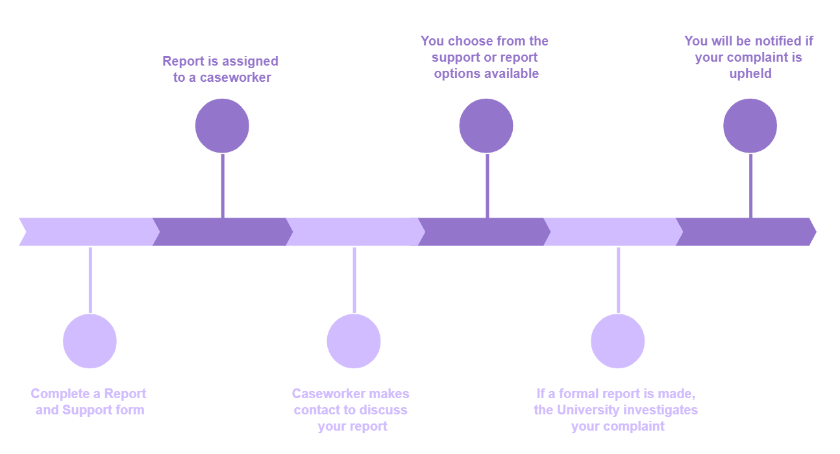
If a report is completed on Report and Support, it does not automatically result in a formal complaint to the University. An allocated caseworker will work with you (the student) to help you make decisions on next steps, which could include access to support only, or to follow a formal reporting route through the University or externally to the Police. Below, we have broken the reporting form down into sections:
1. Complete a Report and Support Form
The student, or someone on behalf of the student, fills out the sections on the reporting form. The person reporting can make special requests for a certain type of advisor, for example if they wanted to speak to a female, or a person of colour. The last page of the form will ask for details of who we should speak to about this report.
2. Report is assigned to a caseworker
All reports come through the system and an email is sent to the Report and Support administrators. Student cases are assigned to the Advice and Response caseworkers, taking into consideration any special requests made on the form.
3. Caseworker makes contact to discuss your report
Advice and Response will reach out using the contact details shared on the report. This will usually be by email in the first instance, but will also try by phone if we receive no response/if a number is shared. We will usually then arrange an appointment to discuss the report further and find out what a student needs.
4. You choose from the support or report options available
Our service is led by what students need in that moment, as well as planning for anything they may need later on. Ultimately, unless there is a severe safeguarding risk or risk to others, we will follow the choice of a student in what support they may want to access, or whether or not they wish to make a report internally or externally about an incident. We will always aim to empower the student and give them back control over what happens next.
5. If a formal report is made, the University investigates your complaint
The investigation will involve a staff member being assigned to investigate and meet with relevant parties to assess what has happened. We would investigate neutrally, aiming to find out the facts of the case, and will be looking for information that shows that it is more likely than not for an incident to have happened. This may come from a respondent admitting the incident, or for witnesses to have supported an individual's statement. For severe misconduct, it may be that the investigation will result in a referral to a University Disciplinary Panel or Summary Disciplinary Panel.
6. You will be notified if your complaint is upheld.
At the end of the investigation, you will be notified as to whether your complaint has been upheld, and the case if proceeding through a disciplinary process.
Your safety, confidentiality and choices
We understand that speaking about harassment or sexual misconduct can feel difficult. Our approach is designed to support you safely, respectfully, and in a way that gives you control.
Will my information be kept confidential?
Your information will be handled sensitively and shared only when necessary. This may include:
- supporting you
- managing risk or safeguarding concerns
- progressing a formal report (if you choose to make one)
Where possible, we will explain:
- what information may be shared
- who it may be shared with
- why this is necessary
Frequently Asked Questions:
Do I have to make a formal report?
No. You can access support without making a formal report.
You can:
- speak to a caseworker
- explore your options
- decide what happens next in your own time
Who will see my information?
Only relevant staff will have access to your information, and only where needed.
Information is shared on a need-to-know basis to protect your privacy.
Will I have to repeat my experience multiple times?
We aim to minimise this wherever possible.
Staff may share information internally (with your knowledge) to reduce the need for repeated disclosure.
What if there is a risk to me or others?
In some situations, the University may need to act without your consent to protect you or others.
If this happens, we will explain this clearly and support you throughout.